Complex ICT relationships
Licensed activities, services, systems, providers, branches and contracts need consistent linkage.

Use organisation, service, system, supplier and contract relationships to generate schema-controlled RoI views, review readiness gaps and connect DORA work to incidents, assessments and remediation.
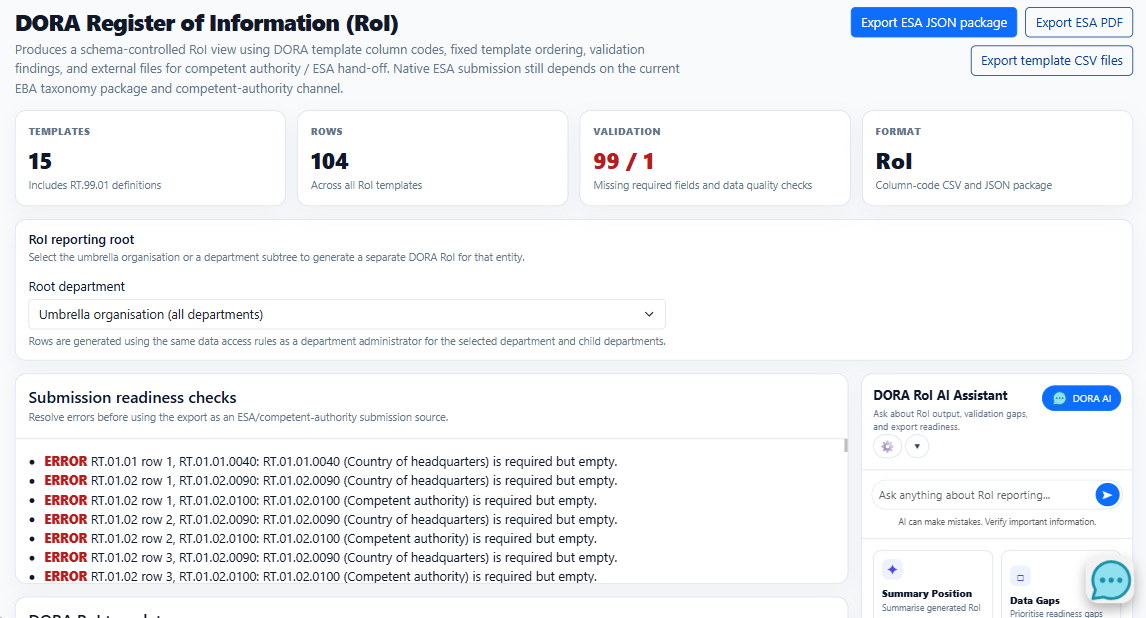
OptiToolkit connects the operating context, assessment evidence, dashboard signal and owned follow-up required to manage the issue.
Licensed activities, services, systems, providers, branches and contracts need consistent linkage.
Required fields and relationship coverage can be difficult to identify before export.
Incidents and remediation are often managed separately from third-party and RoI data.
DORA assessments, contracts and provider reviews need a shared operating context.
Use a shared management cycle from initial scope to visible follow-up.
Capture organisations, branches, activities, services, systems and providers.
Record agreements, data, countries, dates, costs, exit and legal terms.
Connect the ICT and service-chain relationships required for the RoI.
Review required-field and data-quality findings for the selected scope.
Generate fixed-template CSV, JSON and PDF outputs for hand-off.
Connect gaps to assessments, incidents, findings and remediation.
Select an umbrella organisation or department subtree, generate fixed template views and resolve missing information before using the package as a submission source.
Bring the platform components required for a defensible management view into the same solution.
Model branches, activities, services, systems, providers and dependencies.
Explore capabilityCapture provider, agreement, data, country, exit, cost and legal information.
Explore capabilityGenerate structured views and identify missing required information.
Assess compliance, providers, contracts, systems and resilience maturity.
Explore capabilityManage reportability, regimes, deadlines, approvals, submissions and actions.
Explore capabilityMove validation and assessment gaps into owned actions and recurring review.
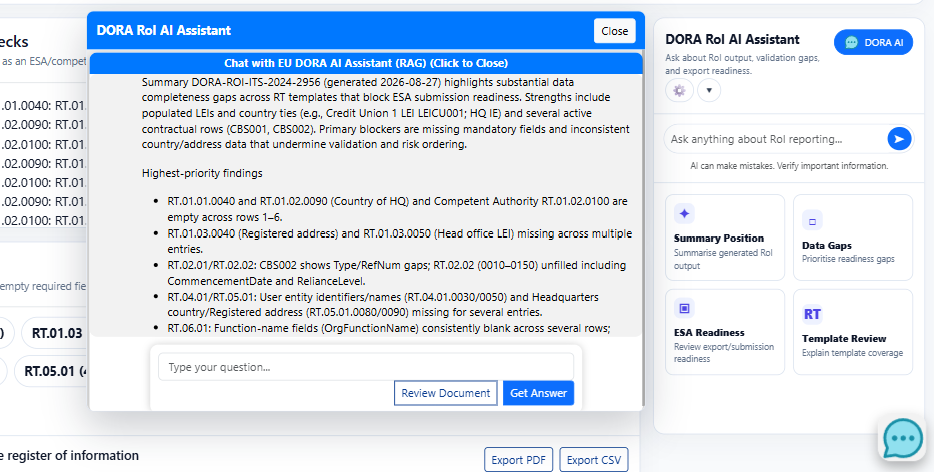
Use the current RoI package and validation context to summarise the position, prioritise missing information and explain template coverage.
Prioritise missing required fields and data-quality findings.
Explain the current output structure and source-record contribution.
AI output and generated packages should be validated against current legal requirements, the EBA taxonomy package and competent-authority guidance.
Keep source context, accountability and follow-through connected.
Connect organisations, ICT assets, providers, contracts and services rather than maintaining isolated rows.
Review missing information and data-quality findings before external hand-off.
Relate RoI gaps to assessments, incidents, owners and follow-up actions.
OptiToolkit produces schema-controlled RoI views and export packages. Native formal submission still depends on the current EBA taxonomy package and the applicable competent-authority channel.
Use a fictional or sanitised organisation, provider set, contract portfolio or current readiness challenge as the focus.